


We are producing 2 design-related apps based on the use of an underlying hexagonal-grid.
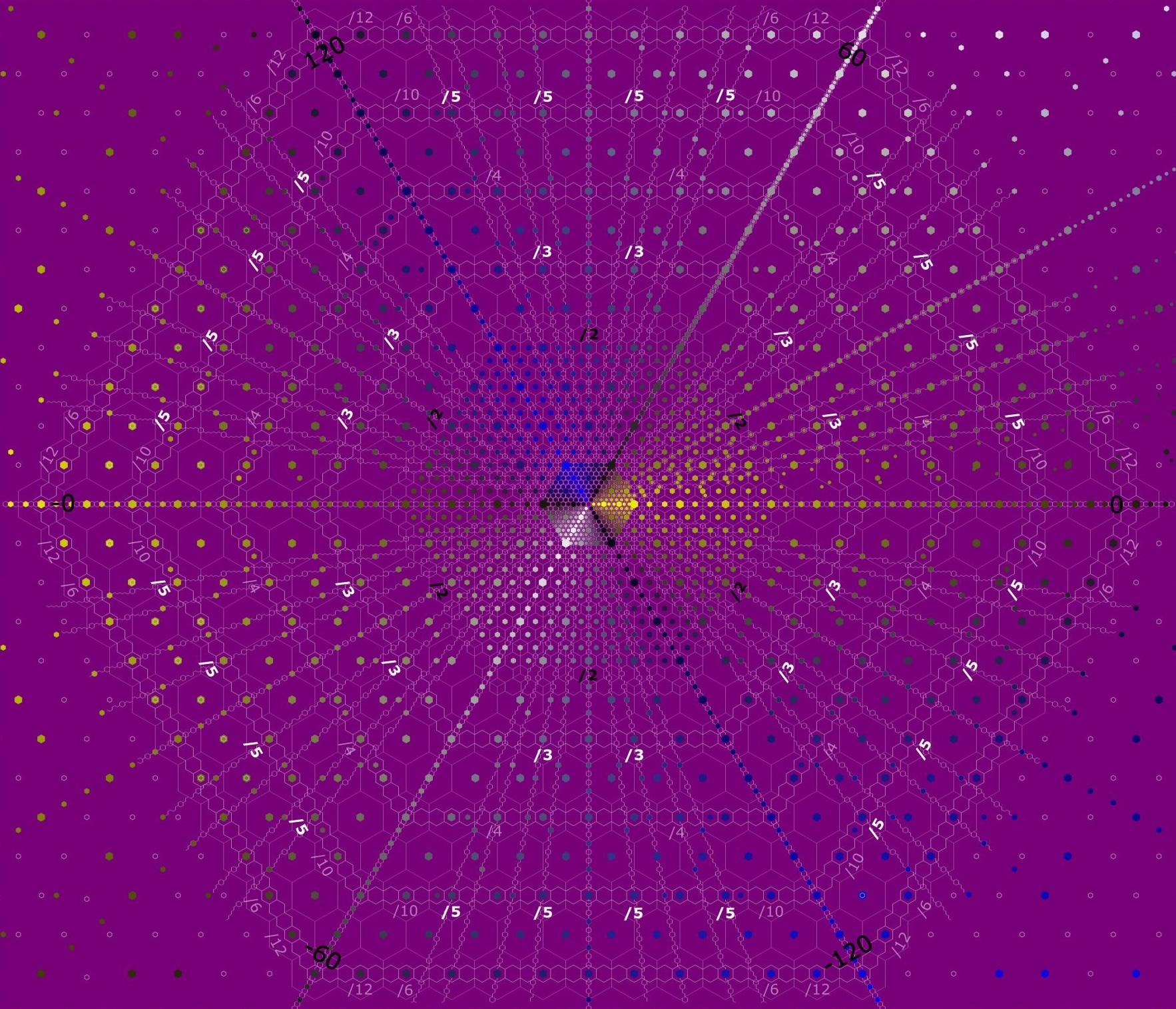
The hexagonal-grid divides 2-space along 3-axes as opposed to 2-axes in the cartesian grid. This division of 2-space gives rise to a lattice of points with special spacing properties that makes the specification of angles and curves very simple.
We are developing a 2D graphic-design tool called Hex-draw and a 3D mechanical-CAD tool called The Specifier.

Hex-draw is a 2D drawing-tool for designing fonts and icons.


The Specifier is an MCAD tool for specifying 3D structural-assemblies.

A Hexagonal grid is like an extended virtual protractor (the instrument used to measure angles). The use of a hexagonal-grid helps choose or specify angles and curves in a 2D graphic-design or mechanical CAD process. It is easy to make small rotations on a hex-grid. In a Cartesian grid based system this is done through numerical (degree) input.

Below is a brief description of various aspects of our design approach.


Hex-draw is being designed in sync with the design of a website.
The Specifier is being designed in sync with the design of a bicycle-stabiliser.
Ergonomix is beign designed to develop both The Specifier and Hex-draw.
The design approach is not to design everything up-front for the most general design scenario, but instead design for a specific use-case, then redesign for more use-cases, then identify those tool aspects that are common across use-cases and add them to a more general-purpose tool. We refer to this as use-centric design.

All 3 apps are being written in C++ and use the native libraries provided by platform vendors.
Hex-draw includes a specially designed hex-grid based 2D graphics library that connects with a platforms cartesian grid based graphics library.
The Specifier includes a specially designed hex-grid based 3D graphics library.
This library does not rely on 3D hardware acceleration,
and is implemented, instead, using a platform's native 2D drawing library.
It is also designed with a minimal feature-set and resource usage approach.
These implementation choices significantly lower computational complexity,
and The Specifier will be very responsive on average PC hardware as a native app.
All existing tools MCAD have high implementation complexity and are either implemented as native apps,
requiring workstation class processors,
or cloud-based apps, implying browser and internet-bandwidth constraints.

Hex-draw creates outputs that are compatible with existing widely used file formats. All of these formats are designed using cartesian coordinate systems. Hex-draw translates its hexagonal grid based vector data to a cartesian system in a user-transparent manner. A conversion tool to import cartesian vector content produced by other tools is planned.
The Specifier will export to and import for the ISO's STEP format.
Ergonomix uses standard c++ files for data exchange with other app-design tools.
We plan to implement Model Context Protocol servers for all our apps so that they can be controlled by AI-agents.